What does BPA-free mean on food containers and bottles?
By FITTO Trade Desk · Last updated 29 October 2026
BPA-free means the plastic was made without bisphenol A, a chemical once common in hard, clear polycarbonate and in the linings of food cans. It tells you one thing only. It does not prove a container is microwave safe, dishwasher safe, free of every other bisphenol or suitable for hot food, so read the other symbols too.
Key takeaways
- BPA-free is about one ingredient, bisphenol A, and nothing else.
- Polypropylene (PP, code 5), PET (code 1), polyethylene and Tritan are not made with BPA; older polycarbonate (code 7) usually is.
- Heat, microwave and dishwasher use need their own symbols on the base or lid.
- Glass and stainless steel contain no BPA, but check what their lids are made of.
Customers ask "is this BPA-free?" at the food storage shelf, and a vague answer costs the sale. This quick answer, for parents, shoppers and retail staff, explains what the label promises and how to read a pack in ten seconds.
At FITTO Food Storage, a wholesale food containers and jars supplier in the UAE, we list BPA-free (خالٍ من BPA) only where the product information states it.
What is BPA, and why do labels mention it?
BPA (bisphenol A) is an industrial chemical used to make polycarbonate plastic and epoxy resins. Labels mention it because regulators have restricted it in food-contact products.
Polycarbonate is the rigid, glass-clear plastic once common in baby bottles and water-cooler bottles. The concern is BPA moving into food, especially with heat.
The EU (2011) and the US FDA (2012) ended its use in baby bottles. In 2023 the European Food Safety Authority sharply lowered its safe daily intake, and the EU adopted a wider food-contact ban in late 2024, phased in over the following years.
Which plastics are BPA-free?
Most everyday food plastics are not made with BPA at all. Polycarbonate is the main exception, and it shares resin code 7 with several BPA-free plastics, so the code alone cannot tell you.
| Material | Resin code | Made with BPA? | Typical use |
|---|---|---|---|
| PET | 1 | No | Single-use water bottles, clear jars |
| HDPE | 2 | No | Milk bottles, some lids |
| LDPE | 4 | No | Bags, squeezy lids |
| Polypropylene (PP) | 5 | No | Food containers, lunch boxes, bottle caps |
| Tritan copolyester | 7 | No | Clear reusable water bottles |
| Polycarbonate (PC) | 7 | Yes, usually | Older hard bottles, water-cooler bottles |
| Glass, stainless steel | None | No | Jars, flasks, containers |
The product label is always the final word. Our comparison of Tritan vs polypropylene water bottles covers clarity, smell and price.
What does BPA-free not tell you?
It does not tell you whether a product can take heat, whether it is food grade, or whether a substitute bisphenol was used.
- Heat use. A BPA-free tub can still warp in a microwave; see our microwave-safe plastic containers guide.
- Other bisphenols. Some makers swapped BPA for relatives such as BPS or BPF.
- Food contact. The glass-and-fork symbol or "food safe" wording shows this, not the BPA claim.
- Condition. Replace scratched, cloudy or warped containers, whatever the label.
How do you read a BPA-free label on packaging?
Check four things on the base, lid or box: the words "BPA-free", the resin code, the food-contact symbol and any heat symbols.
- Find the claim in words. Printed "BPA-free" is clearer than a logo.
- Read the resin code. A 5 means PP; a 7 needs a material name, such as "Tritan" or "PC".
- Look for the glass-and-fork symbol or "food safe" wording.
- Check heat marks for microwave, dishwasher and freezer on base and lid.
In UAE summers, keep bottles out of parked cars and direct sun, as high heat can deform any plastic.
Is glass or stainless steel a better choice?
Glass and stainless steel contain no BPA, so they suit buyers who prefer to avoid plastic touching food or drink. They are heavier and usually cost more per piece.
Their lids are often plastic, so check those too. PP and Tritan are lighter and fine for most daily use; see stainless steel vs plastic water bottles.
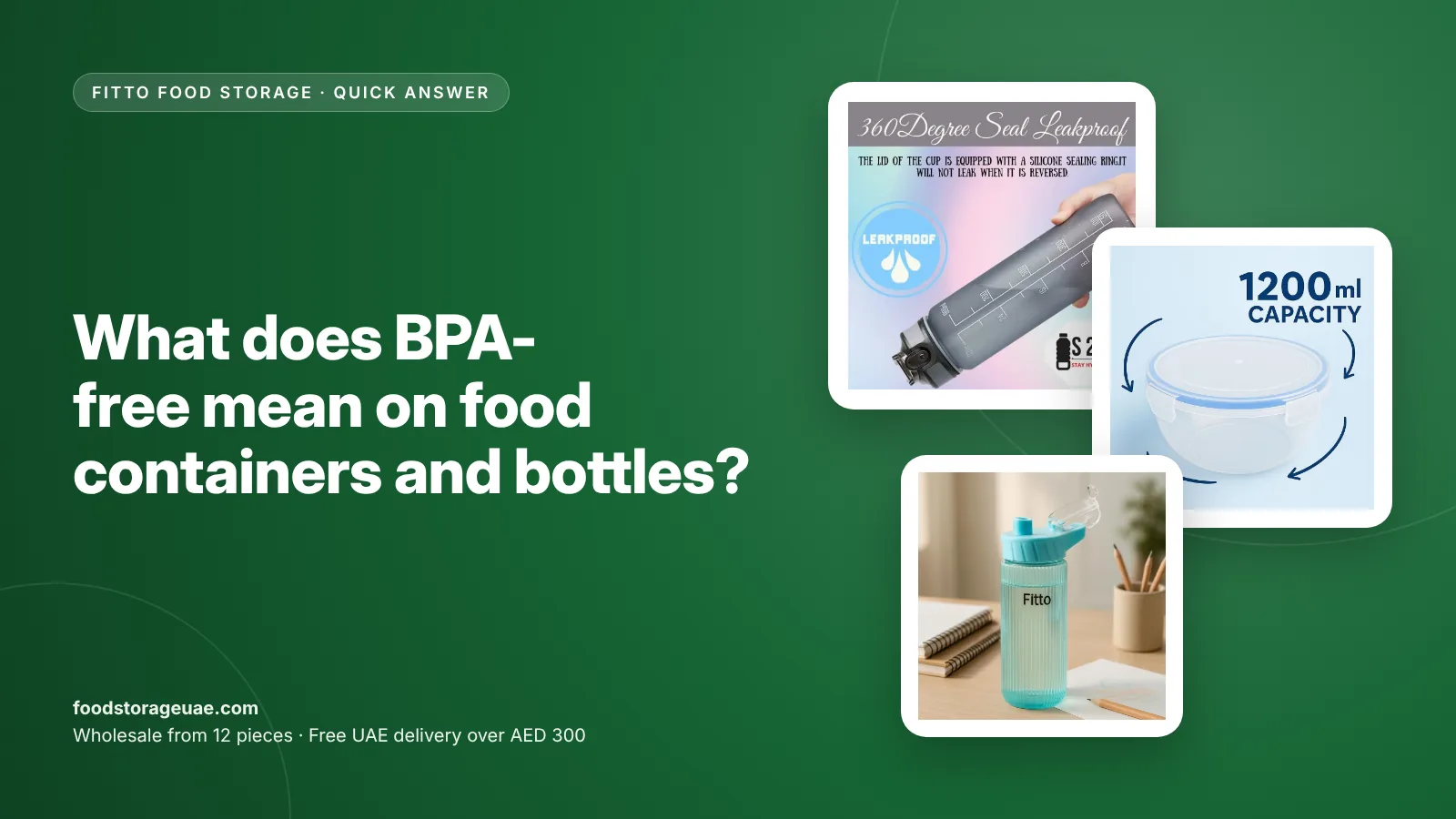
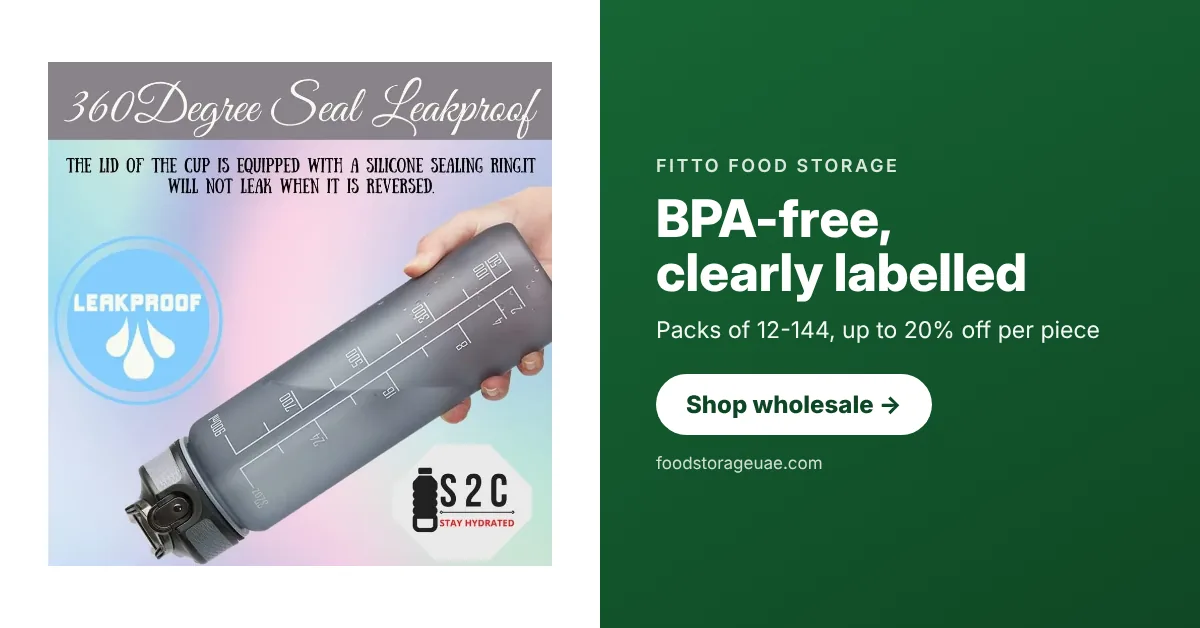
FITTO Trade Pick: Labelled BPA-free, ready to answer the question The 1 L Tritan water bottle with time marker and the 750 ml plastic sport bottle are both listed as BPA-free, as are the 1200 ml airtight food storage box and the microwave-safe 1.4 L rectangular container. Order in packs of 12 to 144 pieces and save up to 20% per piece on the biggest pack.
The bottom line
BPA-free means the item was made without bisphenol A, which is useful but narrow. Read the resin code, the food-contact symbol and the heat marks as well, and replace containers that are warped or deeply scratched.
Browse wholesale food containers and jars and water bottles, request a quote, order a sample or WhatsApp us on +971 55 672 6947. Delivery is free across all seven emirates on orders over AED 300. FITTO Food Storage: fit for the way you store.
FAQ
Is BPA-free plastic completely safe?+
It means one chemical of concern is absent, not that a product is risk-free in every use. Use plastic only as its label allows, keep it out of high heat unless marked for it, and replace worn items. For health questions, speak to a doctor.
Is Tritan BPA-free?+
Yes. Tritan is a copolyester made without BPA. It shares resin code 7 with polycarbonate, so look for the word Tritan rather than the number alone. It is popular for clear reusable bottles because it resists cracking.
Are polypropylene food containers BPA-free?+
Yes. Polypropylene (PP, code 5) is not made with BPA, which is one reason most food containers and lunch boxes use it. Only PP containers marked microwave safe should go in the microwave.
Should I throw away old plastic bottles that are not labelled BPA-free?+
Not necessarily. Many older bottles are PET or PP, which are not made with BPA. Replace a hard, glass-clear bottle marked 7 or PC if you prefer to avoid BPA, and any bottle that is cracked or cloudy.