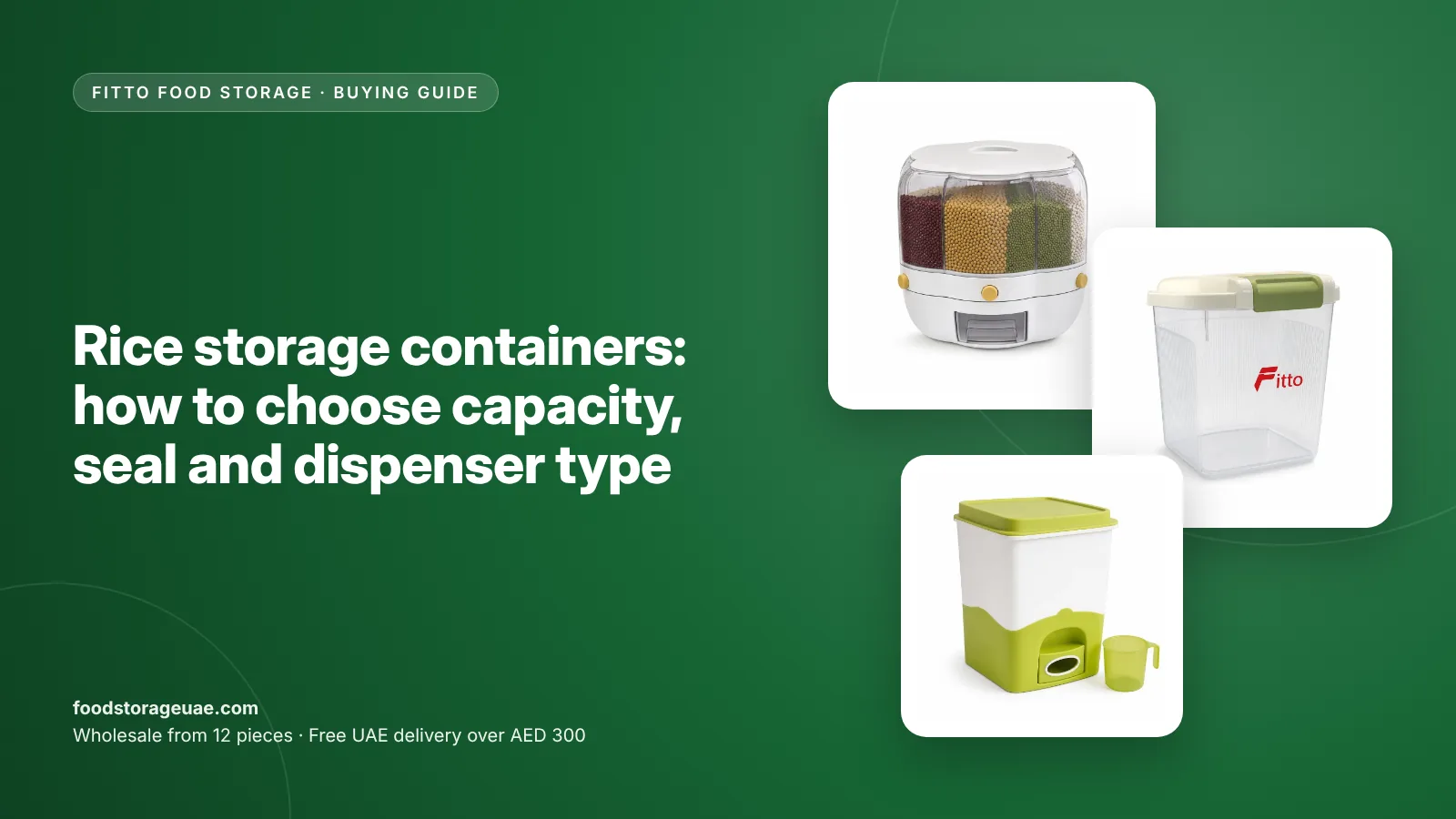
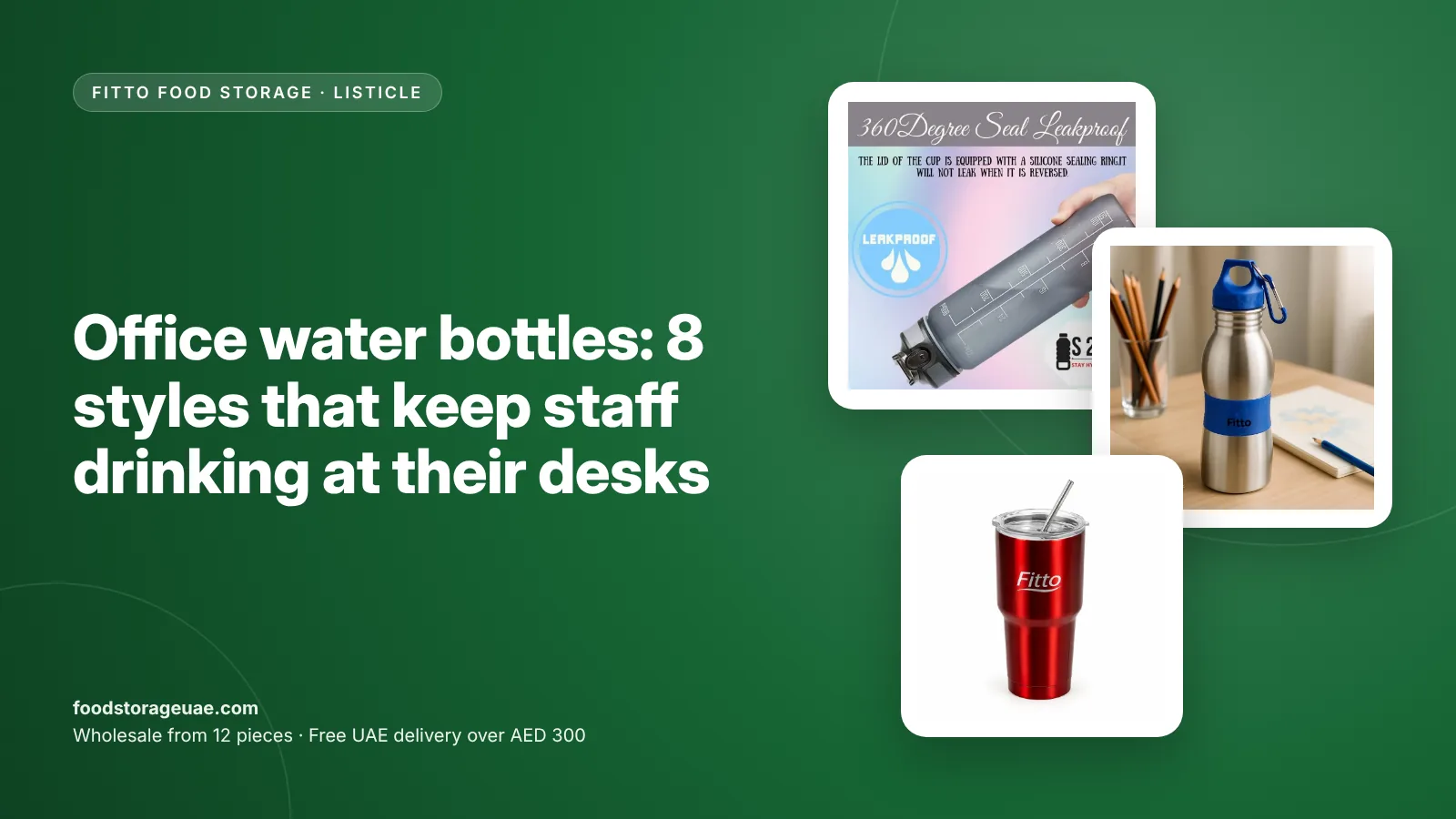
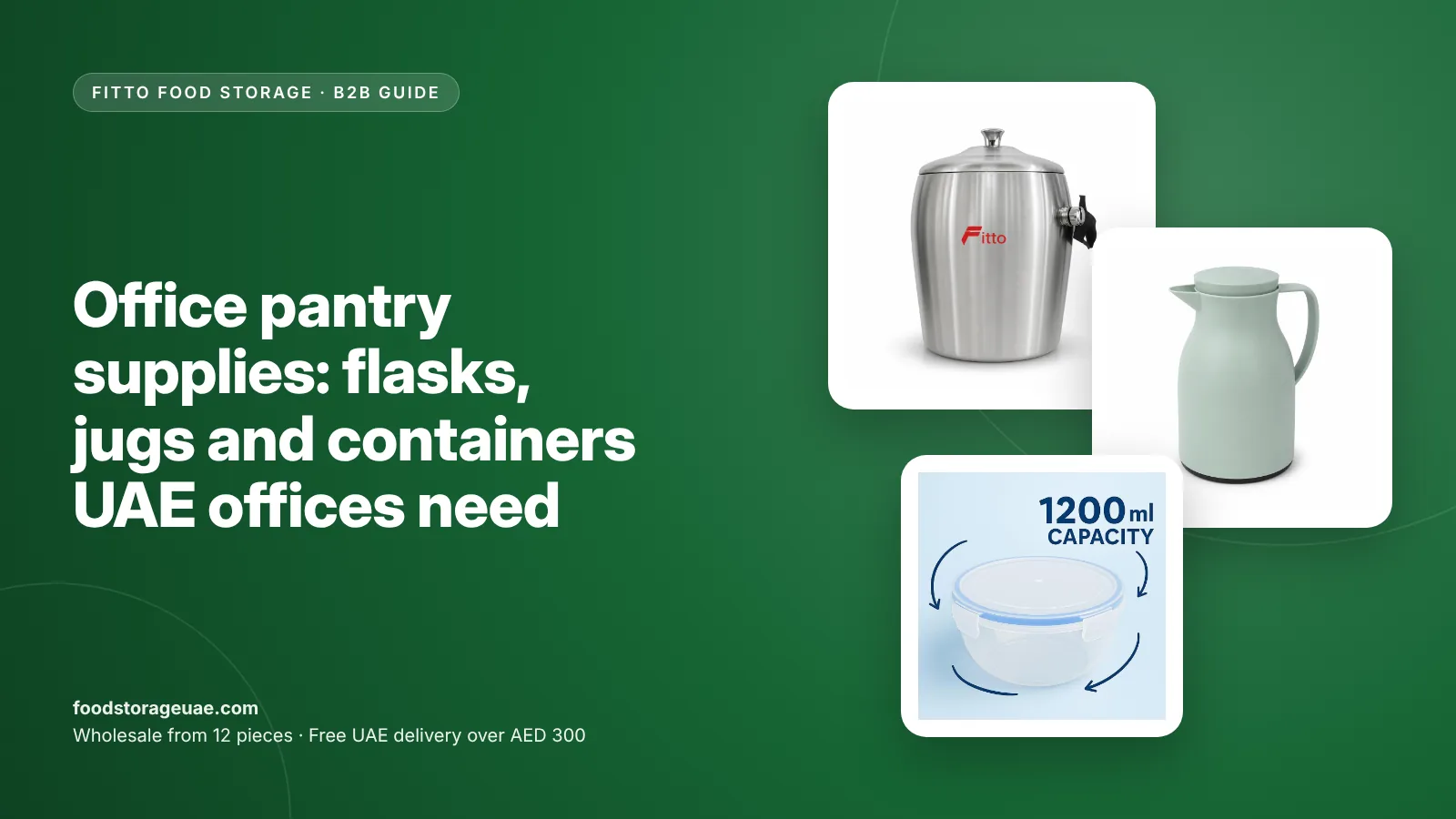
Food storage containers: the complete UAE trade buyer's guide
By FITTO Trade Desk · Last updated 29 October 2026
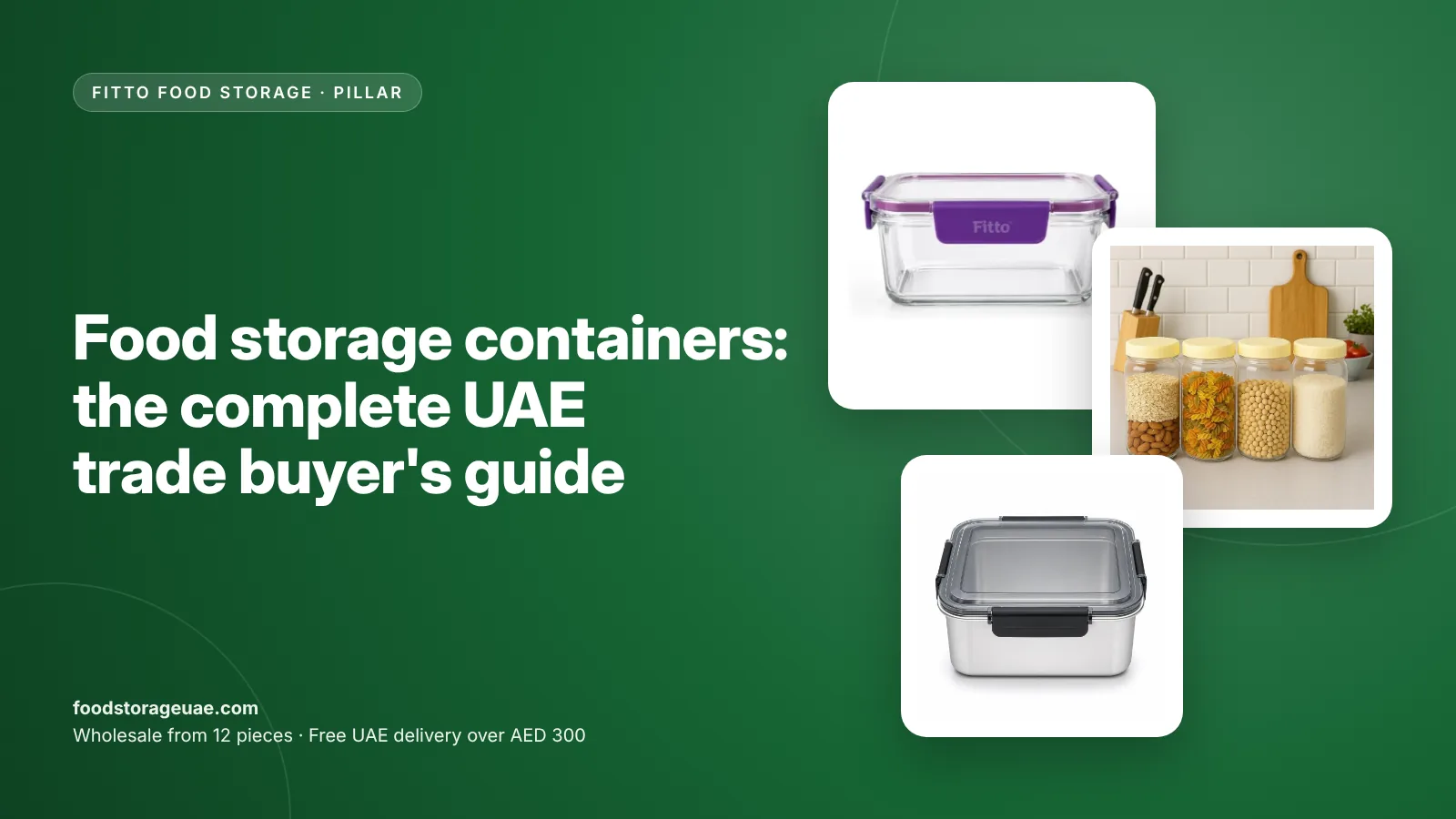
Food storage containers in the UAE come in four working materials: polypropylene (PP), PET, glass and stainless steel. Choose by use first (fridge, freezer, microwave, pantry or display), then by seal type, then by size. A balanced trade range covers three size bands in two or three materials, with at least one leakproof line.
Key takeaways
- Match the material to the job: PP for everyday use and reheating, PET jars for dry goods, glass for reheating and display, steel for durability.
- The seal matters as much as the material. Four-side clip lids with a silicone ring suit liquids; screw and flip lids suit dry goods.
- Three size bands (under 500 ml, 800 ml–1.5 L, 2 L and above) cover most household and café requests.
- Rectangular, stackable shapes save fridge and shelf space; keep a few round tubs for soups and pouring.
- Test one piece of every new line for leaks, staining and lid strength before you stock it in depth.
A food storage container (علبة حفظ الطعام) that cracks, stains or leaks soon becomes a customer complaint. In a Dubai summer kitchen, with high humidity and a fridge door that opens all day, weak lids fail sooner. This guide settles which materials, seals and sizes to stock, so your range sells and your returns shelf stays empty.
It is written for kitchenware shops, resellers, café and restaurant buyers, and serious home cooks. At FITTO Food Storage, a wholesale food storage supplier in the UAE, we hear the same questions from all of them.
What are the main types of food storage containers?
Food storage containers fall into five working types: lidded boxes, jars and canisters, compartment boxes, dispensers and insulated containers. Each type solves a different storage problem, so a good range carries a few of each rather than ten versions of one.
- Lidded boxes. Rectangular, square or round boxes for leftovers, meal prep and fridge storage. This is the volume line in most shops.
- Jars and canisters. Screw, flip, clamp or bamboo lids for rice, pulses, spices, sugar, coffee and snacks.
- Compartment boxes. Two, three, four or eight sections under one locking lid, for meal prep, dates, nuts and sweets.
- Dispensers. Cereal and rice dispensers, including 10 L rice containers and a wall-mounted six-compartment grain dispenser.
- Insulated containers. Insulated plastic food containers and stainless steel hot pots that keep cooked food warm for serving.
Which material is best for food storage containers?
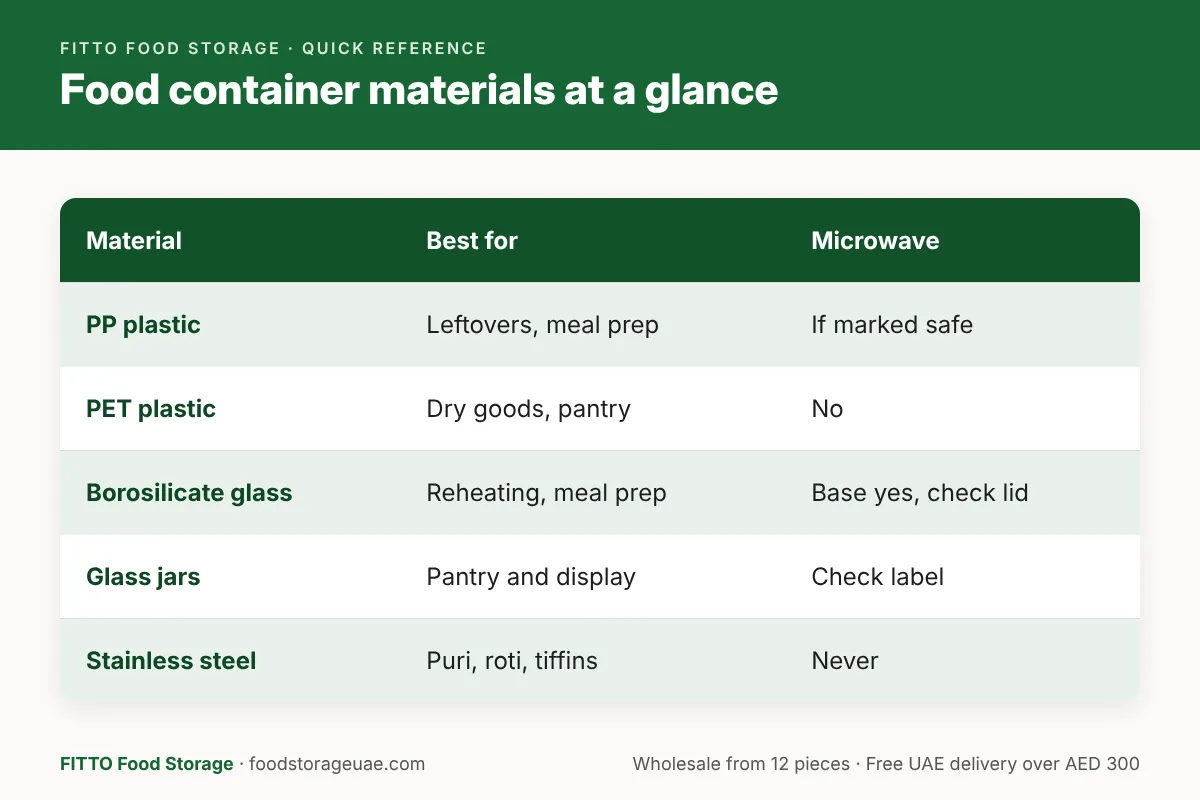
No single material is best; each one wins a different job. PP is light and affordable, PET is clear and suits dry goods, glass reheats well and looks premium, and stainless steel lasts longest.
| Material | Best for | Microwave | Weight | Breakage risk | Shelf appeal |
|---|---|---|---|---|---|
| Polypropylene (PP, code 5) | Leftovers, meal prep, school and office food | Only when marked microwave safe; lid vented | Light | Low | Practical |
| PET (code 1) | Dry goods: rice, pulses, nuts, snacks | No | Very light | Low, can scratch | Clear and tidy |
| Borosilicate glass | Reheating, meal prep, oven-to-table | Yes for the base; check the lid | Heavy | Medium | Premium |
| Standard glass jars | Pantry and display storage | Check the label | Heavy | Medium | High |
| Stainless steel | Puri and roti, tiffins, durable storage | Never | Medium | Very low | Traditional |
PP containers are the backbone of any range. They are light, stack well and survive drops. Several FITTO plastic lines, such as the 1,200 ml airtight food storage box, are listed as BPA-free, microwave safe and dishwasher safe. The trade-off is staining: turmeric and tomato sauces can tint plastic over time.
PET jars are clear and light, which makes rice, lentils and snacks easy to see. They are for cold and dry storage only, so keep them away from hot food and the microwave.
Glass containers do not hold smells or stains, and customers trust them for reheating. Borosilicate glass handles temperature change better than standard soda-lime glass.
Stainless steel containers are almost unbreakable and familiar to South Asian and Arab households for puri, roti and tiffin lunches. They are not see-through and never go in the microwave.
Which lid and seal types should you stock?
Stock at least three seal types: snap lids for everyday use, four-side clip-lock lids with a silicone ring for liquids, and screw or flip lids for dry goods. The seal decides whether the container leaks in a school bag or keeps rice dry through a humid August.
| Seal type | How it works | Best for | Watch out for |
|---|---|---|---|
| Snap lid | Lid presses onto the rim | Fridge leftovers, dry snacks | Not leakproof when tipped |
| Four-side clip-lock with silicone ring | Four hinged clips press a gasket onto the rim | Soups, curries, marinades, meal prep | Gasket must be removed and washed |
| Screw lid | Threaded lid on a jar neck | Spices, sugar, pickles, nuts | Thread can cross if overtightened |
| Flip or pour-spout lid | Hinged flap on a canister lid | Rice, cereal, pulses, coffee | Less airtight than a gasket |
| Clamp lid | Wire clamp presses a rubber ring | Glass jars for coffee, dates, sweets | Ring wears with heavy use |
| Vacuum-sealed lid | Air is pressed or pumped out | Freshness-sensitive foods | Higher cost per piece |
Four-side clip lids are the safest choice for liquids. A good example is the 800 ml glass container with four-side locking clips. For dry goods, a screw or flip lid is quicker to use and keeps the price per piece lower.
For a deeper look at gaskets and locking lids, read our guide to airtight food containers.
What sizes of food container sell best in the UAE?
Three size bands cover most requests: small (85–500 ml), medium (800 ml–1.5 L) and large (2 L and above). Small sizes sell for dips, spices and lunch boxes. Medium sizes sell for leftovers and meal prep. Large sizes sell for family cooking, flour, rice and catering.
| Size band | Typical capacity | Common uses | Who buys |
|---|---|---|---|
| Mini | 85–250 ml | Sauces, dips, spices, baby snacks | Parents, cafés, takeaway |
| Small | 300–500 ml | Single portions, nuts, school snacks | Office workers, schools |
| Medium | 800 ml–1.5 L | Leftovers, meal prep, salads | Families, meal-prep sellers |
| Large | 2–2.3 L | Family curries, batch cooking, flour | Large households, caterers |
| Bulk | 5–10 L | Rice, sugar, flour, pet food | Families, restaurants |
Many UAE households buy rice in 5 kg or 10 kg bags. As a rule of thumb, a 10 L container holds roughly 7 to 8 kg of long-grain rice, so it takes a full 5 kg bag with room to spare. That makes 10 L rice containers and dispensers steady sellers, especially before Ramadan.
A practical rule for shops: stock three to four capacities per material, not seven. Customers choose faster, and you hold less slow stock.
How do stacking and footprint affect a container range?
Rectangular and square containers waste less fridge and shelf space than round ones, so they should make up most of a household range. Round containers pour better and suit soups, so keep a few in each size band.
Stackable lids matter more than most buyers think. If lids of the same footprint stack on each other, a customer can build a tidy fridge with three sizes.
For shop shelving, nesting sets save space too. A three-piece or seven-piece set takes the shelf space of its largest box. When you compare prices, check the piece count in each product title, because a set is priced as one piece.
Are plastic food containers safe for hot food and the microwave?
Plastic food containers are suitable for the microwave only when they are marked microwave safe, and PP is the plastic most often used for this. Remove or vent the lid, avoid heating oily food to very high temperatures, and replace containers that are cracked or deeply scratched.
PET jars and most thin takeaway containers are not designed for reheating. For hot food that goes straight from the pot, glass or stainless steel is the calmer choice.
This is general guidance, not a safety certification. Always follow the label and the product page for each line. If you sell to schools or nurseries, ask for the food-contact documents your tender requires before you commit.
Our glass vs plastic food containers comparison sets out where each material wins.
How should cafés and restaurants choose food storage containers?
Cafés and restaurants should choose clear, stackable containers with locking lids in a few standard sizes, so staff can see stock levels and labels at a glance.
A small café kitchen usually needs:
- Prep boxes of 800 ml to 2.3 L for chopped vegetables, sauces and marinades.
- Drain-insert boxes for washed salad leaves and herbs, such as the clear rectangular container with drain insert.
- Compartment boxes for toppings, garnishes and baked goods.
- Screw-lid jars for sugar, cocoa, nuts and syrups.
- Mini round containers for dips and dressings on takeaway orders.
Label every box with the contents and the date. In hot, humid kitchens, a simple first-in, first-out rule cuts waste more than any container feature does.
How do you build a balanced food storage range for a shop?
A balanced shop range covers every use with three price tiers: an entry PP tier, a mid tier of PET jars and clip-lock boxes, and a premium tier of glass and stainless steel. Start narrow, test each line, then deepen the lines that sell.
| Range block | Entry tier | Mid tier | Premium tier |
|---|---|---|---|
| Lidded boxes | Snap-lid PP boxes, 3-piece sets | Clip-lock boxes with silicone ring | Borosilicate glass with PP lids |
| Pantry jars | PET jars, 6-piece sets | Flip-spout canisters | Glass jars with bamboo or clamp lids |
| Meal prep | Mini round sets | 2- to 8-compartment boxes | Glass containers with dividers |
| Bulk storage | 5 L PET jar | 10 L rice container | Wall-mounted grain dispenser |
| Specialist | Egg trays, fruit crispers | Vacuum-sealed sets | Stainless steel boxes and tiffins |
For a new shelf, 15 to 25 lines is enough to test demand. Put the entry tier at hand height, glass at eye level and bulk storage on the bottom shelf. For a full shelf plan, see how to stock a food storage aisle.
Season matters too. Demand for rice dispensers, large boxes and freezer containers rises before Ramadan and Eid al-Adha. Lunch boxes and small containers lead in August, before the school year starts. Gift-ready glass jars sell well from November to January. Our White Friday food storage stock plan covers the November rush.
How long do food storage containers last, and when should they be replaced?
With normal care, glass and stainless steel containers last for years, while plastic boxes need replacing once they crack, warp, stay cloudy or hold smells after washing. Gaskets and clips usually wear out before the box itself.
Simple care habits make every material last longer:
- Lift out silicone rings every few washes, clean the groove and dry both before refitting. Trapped water is the usual cause of smells.
- Cool hot food before sealing. Steam trapped under a tight lid can warp thin plastic and stress the clips.
- Avoid harsh scourers on PP and PET. Scratches hold stains and make the box look old fast.
- Store lids open or loose in the cupboard, so the gasket keeps its shape and the box airs out.
- Bring glass to room temperature before it goes from fridge to microwave or oven.
How do you check quality before stocking a new line?
Test one piece of each shortlisted container the way your customers will use it. A 20-minute test at your counter saves a returns problem later.
- Fill it with water and turn it upside down over a sink for one minute. Check every corner of the lid.
- Open and close the lid 20 times. Clips should snap firmly without whitening or cracking.
- Check the gasket. It should lift out for washing and sit back flat.
- Wash it the way your customers will, by hand or in a dishwasher if the label allows.
- Store something strong, like a curry or garlic paste, overnight and check for smell and staining.
- Stack it with its own size and the next size up, and check the stack is stable.
If a piece passes, you have a line you can sell with confidence. If it fails, you have lost one container, not a carton.
FITTO Trade Pick: Glass, PP and steel containers that seal tight Start with the 800 ml glass clip-lock container, the 1,000 ml PET jar 6-piece set and the square stainless steel container with locking lid. Wholesale prices start from 12 pieces, packs go up to 144 pieces for up to 20% off per piece, and delivery is free across the UAE over AED 300.
The bottom line
The right food storage container depends on the job: PP for everyday use, PET for dry goods, glass for reheating and display, and stainless steel for durability. Stock three seal types and three size bands, test each new line, then scale the winners.
Browse our wholesale food containers and jars or the full food storage range. For a mixed carton or a regular supply, request a quote. Order a sample at the single-piece price, and its cost is credited on a bulk order of AED 2,000+ within 30 days, or WhatsApp us on +971 55 672 6947. FITTO Food Storage: fit for the way you store.
FAQ
Are glass food containers better than plastic?+
Glass food containers are better for reheating, resisting stains and premium display. Plastic containers are lighter, cheaper per piece and less fragile around children and in lunch bags. Most shops stock both: PP for everyday and school use, borosilicate glass for meal prep and for customers who reheat at work. The right choice depends on the buyer, not on one winner.
Which food containers are best for rice in the UAE?+
For rice, a 10 L container or dispenser suits most family kitchens. As a rule of thumb it holds roughly 7 to 8 kg of long-grain rice, so a full 5 kg bag fits with room to spare. Look for a flip-lock lid or a rotating dispenser with a portion outlet. In humid months, keep it away from the sink and stove, and wipe it dry before refilling.
Can food storage containers go in the freezer?+
Most PP and glass food containers can go in the freezer when the label says so, but leave about 2 cm of headspace because liquids expand as they freeze. PET jars are designed for dry pantry goods, so keep them out of the freezer unless the label says otherwise. Thaw glass in the fridge rather than moving it straight from freezer to microwave or oven.
How do you remove turmeric or tomato stains from plastic containers?+
Wash the container in warm soapy water soon after use, then rub the stain with a paste of baking soda and water and leave it for a few hours. Sunlight on a balcony also fades turmeric stains on PP well. To prevent stains, cool curries before storing them and keep strongly coloured sauces in glass instead.
What does BPA-free mean on a food container?+
BPA-free means the plastic is made without bisphenol A, a chemical once common in some hard, clear plastics. Most PP and PET containers are made without BPA anyway. The label tells you about one substance only, so still follow the microwave, dishwasher and temperature guidance printed on each product.